What is Translation Software and How Does it Work?
Translation software has revolutionized how we communicate across languages. It simplifies the daunting task of translation, making it accessible to many. Dr. James Lin, a leading expert in translation technology, states, “Translation software bridges language gaps but may not capture cultural nuances fully.” This insight reminds us of the limitations present in even the most advanced tools.
Many people rely on translation software. It helps with everything from translating emails to subtitling videos. However, while the convenience is undeniable, understanding its shortcomings is crucial. Sometimes, phrases and idioms lose their intended meaning. Translation software may not always provide context, leading to potential misunderstandings.
In a globalized world, translation software becomes an essential tool. Yet, users should approach it with caution. Relying solely on technology can lead to missed nuances. The balance between technology and human expertise remains vital. Recognizing these challenges can lead to better communication across cultures.

What Is Translation Software?
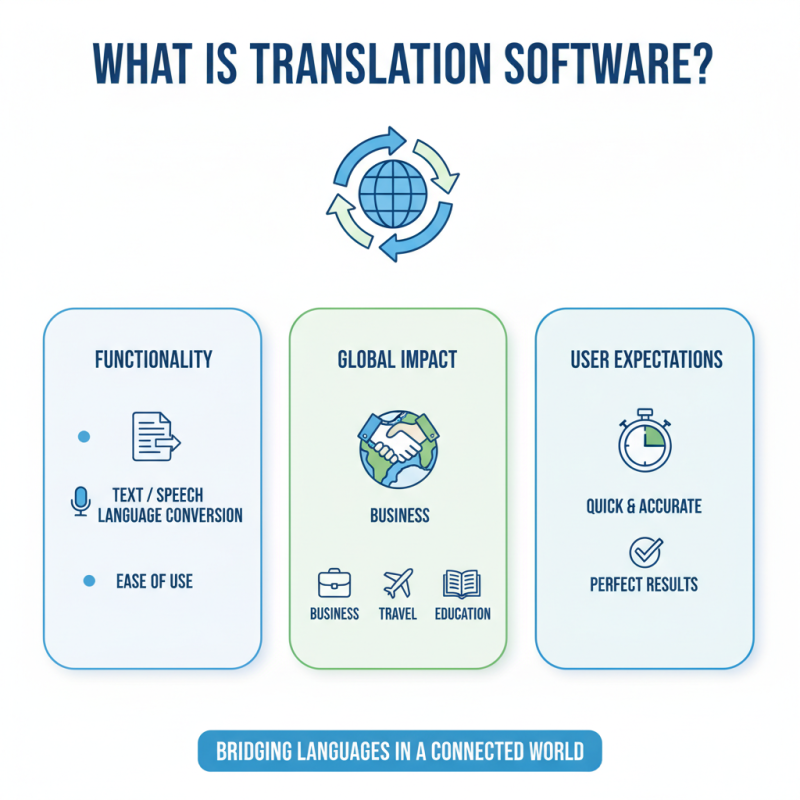
Translation software is a powerful tool designed to facilitate communication across languages. It helps users translate text or speech from one language to another with ease. These tools are particularly helpful in our increasingly globalized world. Multilingual needs arise in various fields, such as business, travel, and education. Users request quick and accurate translations, often expecting perfect results.
However, translation software can sometimes falter. It may misinterpret idiomatic expressions or cultural nuances. For instance, a literal translation can lead to confusion or even offend someone. Words may carry unique meanings in different contexts, which software might overlook. This generates a need for human oversight, particularly when context is crucial.
Despite its shortcomings, translation software remains invaluable. Many users rely on it for rapid translations in real-time conversations or written documents. While it may not be perfect, its ability to provide instant translations has transformed how we interact with multiple languages. Acknowledging its limitations is essential for improving communication.
The History of Translation Software Development
The evolution of translation software has been remarkable. Early efforts date back to the 1950s, when researchers began creating programs for simple word substitution. However, these initial systems struggled with context and nuance. Progress was slow, and many doubted whether machines could truly grasp human language.
In the 1990s, the introduction of statistical machine translation marked a turning point. These systems utilized large data sets to improve accuracy. According to a report by the Globalization and Localization Association, the market for translation technology was valued at approximately $3 billion in 2020. The growth reflects an increasing reliance on these tools in business and communication.
Despite advances, challenges remain evident. Current software often translates idiomatic expressions poorly. Errors can lead to misunderstandings. A study found that 40% of users encountered issues with context and tone. This highlights a gap between human and machine translation abilities. Continued refinement is necessary to bridge this divide.
How Translation Software Works: Key Features and Technologies
Translation software has transformed how we communicate across languages. At its core, it uses various technologies to break down language barriers. The primary feature is machine learning, which helps the software understand context and nuance. This enables more accurate translations.
Natural Language Processing (NLP) is another key technology. It interprets human language in a way that machines can understand. This makes translations not just literal, but also contextually relevant. However, translations are not always perfect. Some phrases may lose their meaning or have multiple interpretations.
User input can enhance translation accuracy, but it is still a work in progress. Human feedback helps the software learn and improve over time. Yet, cultural nuances can sometimes be ignored. The software might miss idiomatic expressions, leading to awkward translations. Users should remain aware of these limitations, as reliance solely on technology can be misleading.
Types of Translation Software Available in the Market
Translation software comes in various types, catering to different user needs. One common type is machine translation, which uses algorithms to convert text from one language to another automatically. This can be useful for quick translations, but it often lacks nuance. Presently, many users find that machine translations can be awkward or incorrect in context. Phrasing may feel off, requiring manual adjustments to convey the intended meaning.
Another notable category is computer-assisted translation (CAT) tools. These programs assist human translators by providing features like glossaries and translation memory. They store previously translated segments, making consistent translations easier. However, these tools depend on user input and historical data, which can sometimes lead to outdated translations or misinterpretations. Frequent updates and careful input are essential for maintaining accuracy.
There are also localization tools, which adapt content for specific regions or cultures. These tools help ensure that translations resonate with local audiences. Yet, it can be challenging to capture cultural nuances purely through software. Misinterpretations can arise, causing frustration for both translators and users. This highlights the importance of human oversight, even in an age of advanced technology.
Types of Translation Software Available in the Market
Applications of Translation Software in Various Industries
Translation software plays a crucial role in various industries.
In healthcare, it enhances patient care. Medical documents need precise translation. Miscommunication can lead to serious risks. Software tools help translate terminologies accurately. This ensures patients understand their conditions and treatments.
In the legal field, accuracy is vital. Legal documents often contain complex language. A simple error can have significant consequences. Translation software can improve initial drafts, but human oversight is still necessary. Review by a professional translator is essential to avoid pitfalls.
The business sector benefits from translation software too. Companies expand into new markets. They need fast translations for marketing materials. However, nuances in language may be lost. Cultural context is not always captured well. This highlights the need for a blended approach, where technology and human expertise work together for the best results.
.svg)


.svg)

.svg)


 052925 - AI Translation 101 (1).png)


.svg)

.svg)


.jpg)